
The End of the "One-Week" Business Trip In the pre-2020 era, corporate travel was defined by the...
Corporate Housing vs. Luxury Hotels: Which is Better for C-Suite?
It's 3 a.m. in a very expensive suite. The air conditioning clicks on, the minibar hums, and your CFO is wide awake for the fourth night running.
She has a board meeting in six hours. The room is beautiful, and she has not slept properly since Tuesday.
This is the part of the corporate housing vs. hotel debate that nobody puts in a spreadsheet. And for C-suite stays, it's the part that matters most.
Everyone Is Comparing the Wrong Numbers
Search this topic, and you'll find the same article fifteen times. Nightly rate versus monthly rate, occupancy tax, meal savings, a tidy table showing corporate housing wins after 30 days.
All of that is true. It's also mostly irrelevant when the traveller is your Chief Revenue Officer.
Surprisingly, nobody is optimising a CEO's housing to save $1,400 a month.
You're optimising for something else entirely. Decision quality on day 40.
So this blog compares the two options on what actually moves the needle for senior leaders. Recovery, focus, privacy, and the number of small decisions they have to make before 9 a.m.
Cost still comes up, because finance will ask. It just isn't the headline.
What Is Corporate Housing?
Corporate housing is a fully furnished residence rented for a set period, usually 30 days or more. Think apartment, townhouse, or private home, move-in ready from hour one.
It comes with furniture, kitchenware, linens, Wi-Fi, and utilities at one rate. No lease negotiation, no furniture rental, no setting up an electricity account in a city you'll leave in ninety days.
The category also goes by other names. Serviced apartments, executive rentals, extended-stay housing, temporary corporate accommodation.
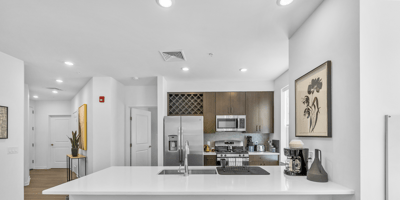
For senior executives, the top tier of this market looks nothing like a dorm for contractors. It looks like a well-appointed home in a good neighbourhood, with hotel-grade cleaning on a schedule you choose.
How Does Corporate Housing Work?
The mechanics are simpler than most people expect. Here's the usual flow.
1. You define the stay. City, neighbourhood, dates, bedroom count, budget band, and any must-haves like a dedicated office or secure parking.
2. Inventory gets sourced. A provider or platform matches your brief against vetted, furnished properties that meet safety and quality standards.
3. You review and approve. Photos, exact location, amenities, and an all-in price rather than a base rate plus mystery fees.
4. The agreement is signed. Typically a short-term licence or corporate lease, often billed monthly and invoiced directly to the company.
5. The executive moves in. Keys or a smart code, a stocked kitchen, working Wi-Fi, and a single contact for anything that breaks.
6. The stay flexes. Projects slip and deals close early, so good providers handle extensions and early exits without drama.
That last point is the real test. Anyone can book a nice apartment, but very few can absorb a three-week extension announced on a Friday afternoon.
What Luxury Hotels Actually Do Better
Hotels are not the villain here. For short, high-intensity trips, a good hotel is close to unbeatable.
- Speed. You can book a suite in ninety seconds at 11 p.m. and be in it tomorrow.
- Zero friction. Someone parks the car, presses the shirts, fixes the dinner reservation, and remembers your coffee order.
- Location. The best hotels sit in the exact districts where boards meet, and deals get signed.
- Optics. Hosting a client for drinks in a hotel lobby is easy. Hosting them in your rented apartment is not.
- Loyalty economics. Elite status, points, upgrades, and consolidated billing that travel programmes are already built around.
For a three-night trip, this is the right answer almost every time. The argument only shifts when the calendar stretches.
Where Corporate Housing Wins for the C-Suite
Now the other side. And notice how little of this is about money.
-
Space that works as an office
A suite gives you a desk in a bedroom. A corporate apartment gives you a separate room with a door that closes.
That matters when a leader is taking calls across three time zones. Nobody wants a boardroom video call with a hotel bed in the background.
-
Privacy and discretion
Senior executives often travel for reasons the market shouldn't hear about yet. Acquisitions, restructures, quiet market entries.
Hotel lobbies are small worlds where people notice each other. A private residence removes that exposure almost entirely.
-
Recovery, not just accommodation
Executives on long assignments don't fail from lack of luxury. They fail from erosion.
Restaurant food seven nights a week, no exercise routine, no laundry rhythm, no kitchen. Small things, compounding daily.
A kitchen and a washing machine sound unglamorous. They're also the difference between arriving at week eight sharp or depleted.
This isn't soft reasoning. Harvard Business Review research cited by GBTA found that 87% of travellers believe the quality of their business travel affects their business results, with almost three in four staff in a World Bank study reporting high travel-related stress.
-
Family can come
This is the quiet dealbreaker. Long assignments are far easier to accept when a spouse or children can join.
Two hotel rooms is a bad answer. A three-bedroom home is a good one.
-
Predictable, defensible cost
One monthly rate, everything included. No nightly rate that spikes because a conference hit town.
Finance likes a number that doesn't move. Procurement likes not reconciling forty line items.
Let's Talk Cost
Because someone always does. And at C-suite level the maths gets more interesting than usual.
Industry composites for 2026 put the average US hotel around $162 per night, roughly $4,865 a month before tax, against roughly $3,300 a month for a fully furnished apartment, all-in. That's a 32–35% gap per person per month at the mid-market level.
There's a structural bonus too. In most US states, stays of 30 consecutive days or more fall outside hotel occupancy tax, which typically runs 6–15%.
Now scale that up. At executive level, a suite in a major market can run three to five times the national average.
Meanwhile, the premium corporate apartment scales far more slowly. The absolute saving gets larger as the room gets nicer, not smaller.
Add the invisible costs. Restaurant meals, laundry, parking, and the productivity cost of an executive who isn't recovering well.
The Executive Stay Test
Here's a simpler way to decide than any cost table. Four questions, answered in about a minute.
1. How long? Under 14 nights, hotel. Over 30, corporate housing. Between the two, ask the next three questions.
2. How visible? If the stay involves confidential work, corporate housing wins on discretion.
3. How much recovery is needed? High-stakes, high-intensity assignments need a kitchen, a gym routine, and space to decompress.
4. Who else is coming? Family, an EA, or a small leadership team pushes hard toward housing.
Three or more answers pointing to housing? Book the apartment.
Two or fewer? Book the hotel and move on.
Side by Side
|
Factor |
Luxury Hotel |
Corporate Housing |
|
Ideal length |
1–14 nights |
30+ nights |
|
Space |
1 room, sometimes a suite |
Full apartment or home |
|
Workspace |
Desk in the bedroom |
Separate office room |
|
Kitchen |
Minibar, room service |
Full kitchen |
|
Laundry |
Per-item charges |
In-unit machine |
|
Cost structure |
Nightly, demand-driven |
Monthly, fixed |
|
Occupancy tax (US) |
Applies |
Usually exempt at 30+ days |
|
Family friendly |
Difficult |
Straightforward |
|
Discretion |
Public lobby |
Private residence |
|
Service |
Concierge, daily housekeeping |
Scheduled cleaning, single contact |
|
Booking speed |
Instant |
Fast with the right platform |
It Doesn't Have to Be Either/Or
The best mobility programmes stopped treating this as a binary. They split the stay instead.
Hotel for the first week, while the executive is in back-to-back meetings and barely sees the room. Corporate housing from week two onward, once the assignment settles into a rhythm.
Or the reverse. Housing as the base, with a hotel booked for two nights when a client dinner needs a lobby.
This is where most companies leave money and goodwill on the table. They pick one lane and stay in it for ninety days.
Which Companies Provide Housing to Employees in the US?
Employer-provided housing in America shows up in three distinct forms.
1. Tech and campus-adjacent housing.Google has invested heavily in housing near its Mountain View headquarters, including modular units built at NASA's Ames Research Centre, and Meta has developed housing around its Menlo Park base.
2. Relocation and temporary lodging packages.Adobe, Google, Amazon, Microsoft, and most large employers fund short-term housing as part of relocation, usually through third-party providers rather than owning stock.
3. Sector-driven housing.Healthcare systems, universities, national parks, resorts, energy and construction firms provide accommodation because the work is remote, seasonal, or in a market where staff simply cannot afford to live.
For executives specifically, direct ownership is rare. Companies overwhelmingly buy temporary housing as a service, because owning inventory in twelve markets makes no sense.
Which Companies Provide Housing to Employees in India?
India's picture is different, and older.
1. Industrial townships. Tata, Reliance, Jindal, NTPC and similar groups have built full residential townships near plants and refineries for decades.
2. IT campus and transition housing. Infosys, TCS, Wipro and HCLTech provide accommodation for trainees at campus facilities and short-term stays of one to a few weeks for relocating staff.
3. Leased corporate apartments. For senior and relocated employees, the norm is a company-leased flat, often inside a cooperative housing society, plus House Rent Allowance in the salary structure.
4. Banking and public sector quarters. SBI and other institutions still allocate graded quarters to certain cadres, alongside housing loans and allowances.
One thing to flag for finance teams. Employer-provided accommodation in India is treated as a perquisite and valued for tax under income tax rules that vary by city population tier, so the structure of the benefit matters as much as the benefit itself.
The Unglamorous Part: Duty of Care and Compliance
Senior leaders are your highest-value, highest-risk travellers. That makes housing a governance question, not just a comfort one.
You need verified safety standards, a known address on record, and a clear escalation path at 2 a.m. Unvetted short-term rentals fail all three.
You also need clean documentation. Consistent invoicing, tax treatment that survives an audit, and one system of record instead of eleven inboxes.
This is where ad hoc booking quietly becomes expensive. Not in rate, but in risk.
What Good C-Suite Corporate Housing Looks Like
If you're specifying a stay for a senior leader, insist on these.
- A room that can function as a real office
- Enterprise-grade internet, verified before arrival, not promised
- Secure building access and secure parking
- A location that respects their actual commute, not just the map
- Professional cleaning on a set schedule
- In-unit laundry
- A full kitchen, genuinely equipped
- One named contact who answers outside business hours
- Flexible extension terms in writing
- All-inclusive pricing with no arrival surprises
Miss two or three of these and the executive will quietly move back to a hotel. Then you'll have paid for both.
Where Nearsite Fits
Most companies don't struggle with the decision. They struggle with the execution.
Sourcing an executive-grade apartment in an unfamiliar market usually means brokers, spreadsheets, scattered vendor lists, and a manual RFP cycle that eats two weeks. That's fine when you have two weeks.
Nearsite was built to remove that lag. The platform centralises professionally vetted temporary housing, rapid placement, and transparent pricing in one place, so mobility, HR and operations teams stop stitching the process together by hand.
The AI-native sourcing engine matches inventory against duration, location, quality standards and budget in real time. Staggered move-ins, sudden extensions, early exits - the platform is designed to absorb the pivots rather than break on them.
And because everything sits in a single system of record, you get visibility and audit-ready documentation instead of fragmented email threads. That's the part finance and legal actually care about.
The Verdict
There isn't one winner, and any article claiming otherwise is selling something.
Short and sharp? Book the hotel. Long and consequential? Book the housing.
But stop making the decision on the nightly rate alone. For your most senior people, the question was never "which is cheaper."
It's "which one gets them to week twelve still thinking clearly." Answer that, and the budget conversation takes care of itself.
Explore how Nearsite reduce TAT in finding the right housing for your C-suite executives
Frequently Asked Questions
1. Is corporate housing cheaper than a luxury hotel?
For stays beyond 30 days, almost always. The gap widens at the executive tier, where hotel suite rates scale much faster than apartment rates.
2. What's the minimum stay for corporate housing?
Traditionally 30 days, though modern platforms increasingly support shorter windows. The 30-day mark also matters for US occupancy tax exemption.
3. Do executives lose hotel-style service?
Not necessarily. Premium corporate housing includes professional cleaning, maintenance and a dedicated contact, just on a schedule rather than on demand.
4. Can a partner or family stay too?
Yes, and that's one of the strongest arguments for housing on assignments longer than a month.
5. Is corporate housing suitable for a two-week trip?
Usually not. Under 14 nights, a hotel is faster, simpler and often cheaper.
6. Is corporate housing the same as an Airbnb?
No. Corporate housing is vetted, professionally managed, contractually structured for business use, and supported by a service layer that short-term rental listings don't provide.